
Client acquisition through live events: How to measure cost and conversion
How to judge a live event by what it wins: cost per client, funnel conversion and the follow-up that turns guests into lasting business.
Client acquisition through live events turns prospective relationships into paying clients. Measure results by comparing outreach and marketing expenses with the number of new clients acquired during the same period. Cost per client gives the event a commercial measure beyond attendance, while conversion rates show how effectively prospects move from initial interest to a booked conversation and, ultimately, a sale. Attendance alone is not the outcome; the quality and progress of relationships matter.
A well-attended event can create visibility, but its value is hard to judge if no one tracks where prospects came from or what happened afterwards. A considered approach to client acquisition through live events links each stage to a clear measure: who was reached, who engaged, who became a qualified prospect and who converted. This guide explains how to calculate acquisition cost, map the journey from awareness to conversion, tailor event messaging and follow up with a relevant invitation to consult. That makes it easier to see which experiences are building meaningful business relationships.
Key Takeaways
• Measure event acquisition cost by relating eligible marketing and outreach expenses to the new clients gained in the same period.
• Track prospects as they move from awareness to consideration and conversion, so you can see where interest advances or stalls.
• Shape event messaging around the audience’s needs, the value you offer and the distinctive reason to engage.
• Follow up with a relevant next step, making it straightforward for interested prospects to book a consultation.
1. Acquisition metrics and customer acquisition cost
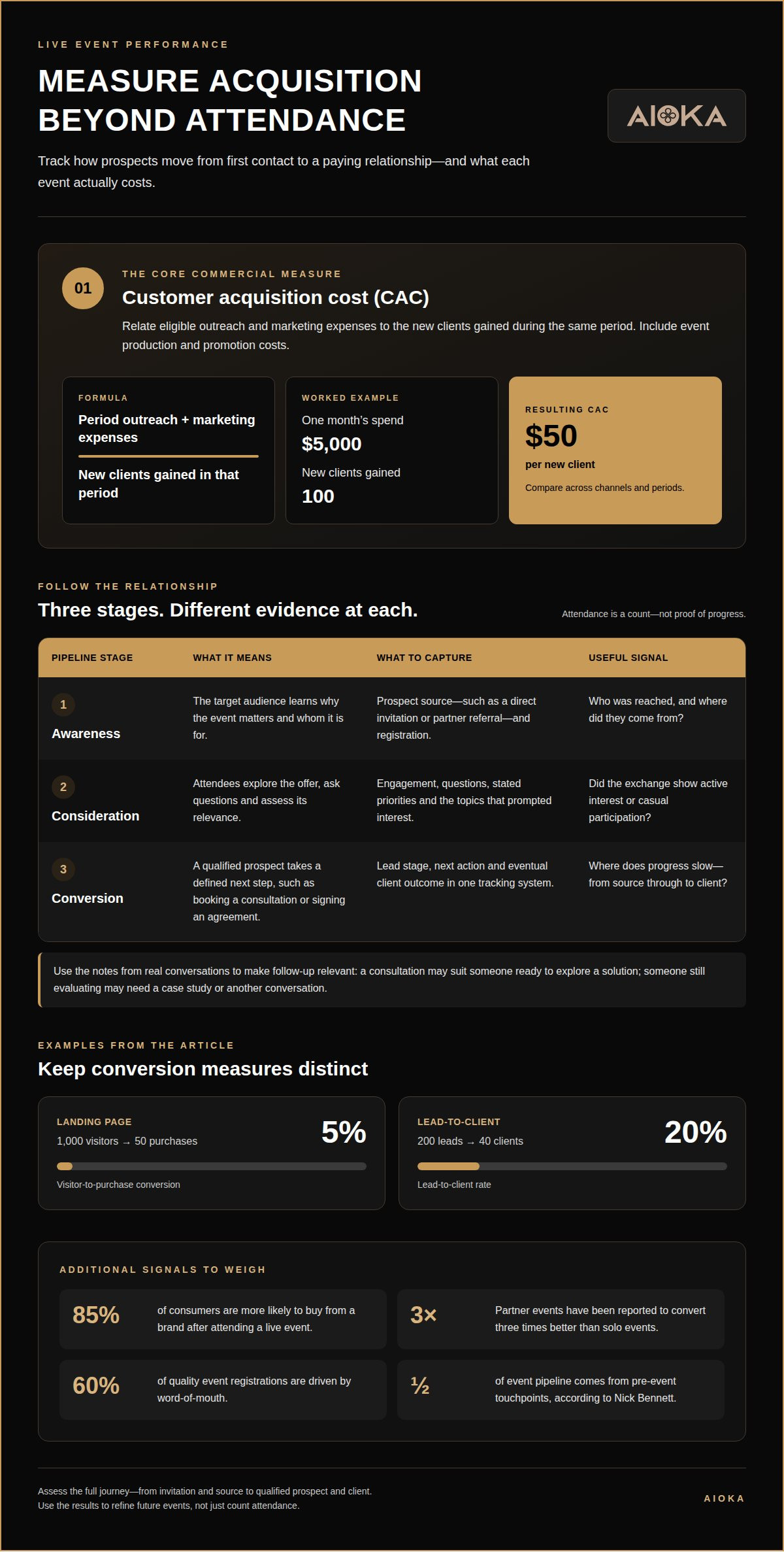
Client acquisition moves a prospect from first contact to a paying relationship. Measure customer acquisition cost (CAC) by dividing period outreach and marketing expenses by new clients gained. For example, spending $5,000 in one month and gaining 100 clients produces a $50 CAC. Include event production and promotion expenses in the calculation, then compare results across channels and periods.
Track awareness, consideration and conversion as distinct pipeline stages. A landing page receiving 1,000 visitors and producing 50 purchases converts at 5%. Separately, 40 clients from 200 leads represent a 20% lead-to-client rate. Customer experience influences purchase decisions: 85% of consumers are more likely to buy from a brand after attending a live event. Record engagement and source alongside each prospect, not attendance alone.
The right format depends on your audience and the relationship you want to build. Partner events, private dinners, industry meetups and educational workshops can bring relevant prospects together. Partner events have been reported to convert three times better than solo events, so a shared audience is worth considering.
In-person events create space for direct conversation and immediate insight into a prospect’s needs. Virtual events can make participation easier across locations, while online registration and follow-up can connect engagement to the pipeline. Choose a format based on audience access, interaction goals and the experience needed to present your offer.
Live events can help businesses acquire clients by creating focused opportunities for prospects to learn, discuss their needs and take a next step. Start by defining your ideal client, shaping the programme around their priorities and choosing channels that reach them. AIOKA’s curated culinary experiences can provide a distinctive setting for meaningful client conversations.
Promote the event through relevant partner networks, personal invitations and a focused landing page with one clear call to action. Capture registrations, then send reminders before the gathering. Word-of-mouth drives 60% of quality event registrations, so make the invitation easy to share with appropriate colleagues.
At the event, record each prospect’s contact details, source and stated interests, then assess their fit and intent. Keep this information in one system and assign a next step so your follow-up reflects the conversation, not a generic pitch.
Common mistakes include judging success by attendance, overlooking event expenses and failing to track lead sources. A sound strategy measures the full journey from invitation to client, then uses the resulting acquisition cost to refine future events.
2. Awareness, consideration and conversion funnel stages
A useful event funnel tracks a prospect from first awareness to purchase. At the awareness stage, the target audience learns why the event matters and whom it is for. During consideration, attendees explore the offer, ask questions and assess its relevance. Conversion happens when a qualified prospect takes a defined next step, such as booking a consultation or signing an agreement.
Build awareness before the event, not just at the venue. Invitations, partner communications and registration pages introduce the subject and explain its relevance. Half of event pipeline comes from pre-event touchpoints, according to Nick Bennett. Track each prospect’s source, such as a direct invitation or partner referral, to understand later engagement in context.
At the event, consideration grows through useful exchanges, not attendance alone. A product demonstration, focused discussion or expert presentation gives the audience something substantive to assess. Capture each prospect’s questions and stated priorities, then note which topic prompted further interest. These records help distinguish active consideration from casual participation and shape more relevant follow-up.
Conversion calls for a clear, proportionate next step. A prospect ready to explore a solution may benefit from a consultation; someone still evaluating may need a case study or another conversation. Assign each lead a stage and action in your customer relationship management software. This keeps the pipeline clear and helps prevent promising interactions from going unaddressed.
Review performance by source and stage instead of treating the event as a single channel. Compare how many prospects from each source registered, engaged, qualified and became clients. Then identify where progress slowed. If referrals lead to strong consideration but few consultations, refine the invitation to take the next step. If registrations rarely lead to engagement, reconsider how well the event meets its audience’s needs.
Thoughtful measurement connects the guest experience with revenue outcomes without reducing the gathering to a headcount. A well-designed setting can support candid conversation and focused attention. For an elegant event experience, explore curated event experiences.
3. Acquisition messaging and differentiation
An effective acquisition message identifies the audience’s problem, the benefit you offer and why your approach is relevant. For example, an event for operations leaders could address fragmented workflows, demonstrate a more coherent process and explain the expertise behind it. This structure attracts prospects whose needs align with your work, rather than relying on broad claims that could describe any business.
Build your message around one central promise, then adapt the detail to each event moment. An invitation can name the challenge and explain what attendees will learn. At the event, a demonstration or customer story can make the benefit tangible. Follow up by connecting the discussion to a relevant next step. Each touchpoint should maintain the same distinction while addressing the prospect’s immediate concern.
Choose an acquisition offer that gives prospects a useful way to evaluate your value. A demonstration suits a considered service; a sample, trial or practical resource may fit another decision. Webinars can also attract an audience through useful instruction, but keep the presentation responsive. Engagement can decline after 23 minutes unless a customer is speaking, so feature a customer perspective before attention fades.
Evidence lends credibility when it reflects the audience’s priorities. A case study can show the original problem, the approach taken and the result, while a testimonial can capture the experience in a customer’s own words. Shama Hyder’s campaign generated more than 100 high-quality leads and increased LinkedIn engagement by 132%. Use evidence selectively, explaining why it matters to the prospect rather than presenting a statistic without context.
Refine your acquisition strategy by comparing which messages attract qualified conversations, not just clicks or registrations. Track the event, audience segment, message and subsequent lead quality together. If a demonstration draws interest but few substantive discussions, clarify the intended audience or the problem it addresses. If a customer story prompts deeper questions, feature that evidence in future invitations. This disciplined comparison helps you create messaging that is distinctive, relevant and easy to act on.
4. Booking consultations after events
Begin follow-up by referring to the attendee’s actual conversation, not a generic greeting. If a prospect raised a specific operational challenge, briefly reflect it and connect the discussion to a consultation focused on that issue. Nick Bennett reports a 72% response rate for follow-ups sent on days 1-2. Timely, relevant contact gives the exchange continuity while the event remains familiar.
Make the next action clear and straightforward. Offer a consultation with a defined purpose, provide a booking option and explain what the discussion will cover. Instead of writing “Let’s connect,” invite the prospect to explore the question they raised and outline a practical outcome. A concise recap, relevant case study or event replay can provide context for attendees who are not yet ready to schedule.
For attendees who are not ready to meet, use a separate follow-up path. Share material related to their stated interest, then invite a response or consultation when the topic becomes timely. Tailored email sequences can sustain engagement, while a customer relationship management system records the campaign, conversation and next action. Review replies and bookings to improve the sequence.
Privacy and consent requirements vary by attendee location and intended use. A prudent process explains why details are collected, limits their use to a clear purpose and obtains permission before sending promotional messages. For example, distinguish an event logistics update from ongoing marketing and make the intended follow-up clear at registration.
Before the event ends, tell attendees how to continue the conversation and where to find any promised materials. Afterwards, assign each consultation request to a responsible team member and record its status. This straightforward handoff helps prevent a promising exchange from being lost between event delivery and sales follow-up.
For an event designed to support meaningful business conversations, plan a considered hospitality experience that gives guests space to engage.
AIOKA: Corporate Hospitality Packages
AIOKA is a natural next step for brands seeking to turn live-event engagement into considered business relationships. Its Corporate Hospitality Packages create an elevated setting for hosting clients at Formula 1 race weekends, while Brand Activation Services help shape a brand presence around the event. Curated Culinary Experiences can complement those interactions with a distinctive hospitality dimension.
Consider an experience that goes beyond a brief introduction, giving guests space to engage with your brand, meet key representatives and continue conversations. The right approach depends on your audience, the relationship you want to develop and the experience that best expresses your brand.
Contact AIOKA to discuss an event experience tailored to your client relationships.
Shape the Next Event Around Lasting Relationships
A considered approach to client acquisition through live events starts with a deliberate choice: design an experience that reflects the relationships your business wants to build. The setting, the conversations it enables and the way your brand is expressed should work together, giving each interaction a clear purpose.
AIOKA brings these elements together through Corporate Hospitality Packages, Brand Activation Services and Curated Culinary Experiences. These offerings support considered client hosting and brand presentation, with the event shaped around your audience and the relationship you intend to cultivate.
Your next step is to define the kind of gathering that would make a meaningful conversation possible, then align the experience with that intention. Contact AIOKA to plan your event strategy, and give your next client relationship a thoughtful place to begin.
Frequently Asked Questions
What is the most important first step in a strong acquisition strategy?
Define your ideal client and the business problem your event should address. If your audience is senior finance leaders, for example, shape the invitation around a relevant commercial challenge rather than a broad promise of networking. Then decide what action would signal genuine interest, such as requesting a tailored discussion. This focus aligns the event’s audience, content and follow-up.
How much does it cost to acquire clients through live events?
There is no universal cost. It depends on the event format, venue, production, promotion, staffing and follow-up, as well as the number of clients acquired. Set a budget across these categories, then assess it against qualified opportunities and resulting clients. AIOKA’s bespoke hospitality package pricing is based on the case, with scope and event requirements shaping the cost.
How should businesses follow up with event attendees to convert them into clients?
Send a personal note that refers to a specific exchange, then propose a relevant next step. If an attendee discussed a launch challenge, for instance, offer a consultation focused on that subject and include a concise agenda. Record their preferred contact method and timing, and set a reminder for the assigned relationship owner. This keeps follow-up considerate and connected to the attendee’s stated interests.
How do you measure live event ROI and client acquisition cost?
Compare event-attributed revenue with the full event cost, and review acquisition cost alongside the quality of resulting clients. Track registrations, qualified opportunities, closed business and revenue by event cohort, including deals that progress later. Nick Bennett says event ROI can take 6-9 months to measure, so establish a consistent review window and attribution method before comparing events. This avoids judging long-cycle opportunities too early.
How can small businesses find local networking and industry events for potential clients?
Look for industry meetups and conferences where potential clients gather. You can also partner with businesses that serve the same audience and reach prospects through their networks.


