
F1 hospitality cost benefit for food and client networking
Weighs the dining, service and networking value of F1 hospitality against its full cost, with guidance on measuring the return on client relationships.
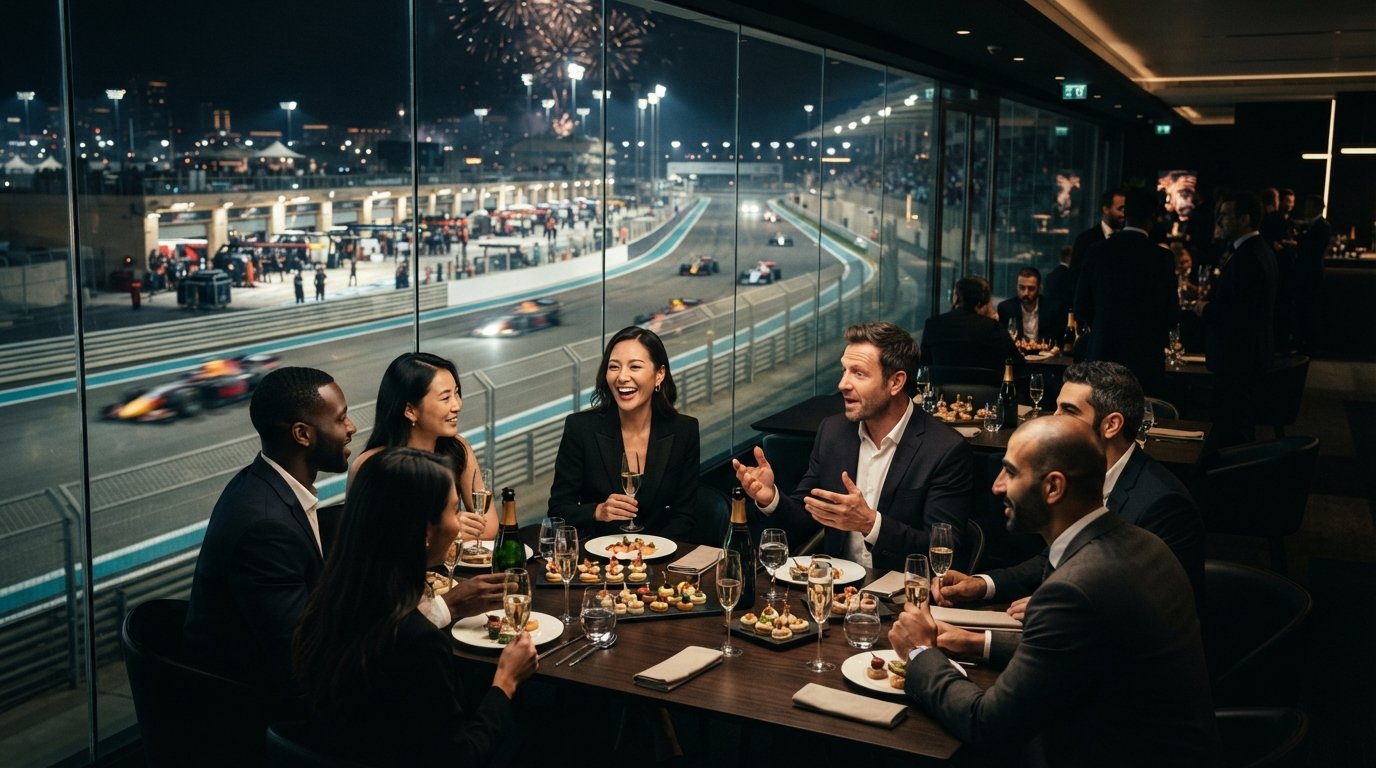
The strongest return from F1 hospitality is not measured by the meal alone, but by how dining and a considered setting support client relationships. A useful F1 hospitality cost benefit analysis weighs the food and beverage experience alongside the time and atmosphere available for meaningful conversation. The value lies in bringing those elements together around a race weekend.
Premium hospitality can make hosting feel effortless, with elevated menus, attentive service and an environment that gives business conversations a memorable context. Yet the benefits depend on what the package includes and how deliberately the occasion is designed around your guests. This article explains how food and beverage inclusions shape the experience, how client networking can contribute to business value, and which practical considerations help you assess whether F1 hospitality aligns with your objectives.
Key Takeaways
• Compare hospitality inclusions by how they support the occasion, from dining and service to the setting for conversation.
• Assess location and weekend logistics together, since race demand can influence accommodation and the overall hosting plan.
• Define client-hosting objectives in advance, then track relationship progress and follow-up alongside direct event expenses.
• Build a complete budget by accounting for travel, accommodation, meals outside the package, and other event-related costs.
• Choose an experience that aligns with your guest profile and business purpose, with culinary and activation elements shaped around the intended outcome.
What benefits and experiences are included in F1 hospitality packages?
F1 hospitality packages can combine race viewing, dining, access and hosting spaces. Their inclusions vary, so compare the experience element by element. The F1 Paddock Club, Champions Club and circuit-specific lounges offer distinct settings. For a business host, each element serves a different purpose. A meal supports conversation, while track access brings guests closer to the event. A reserved seat provides a defined place to watch the race.
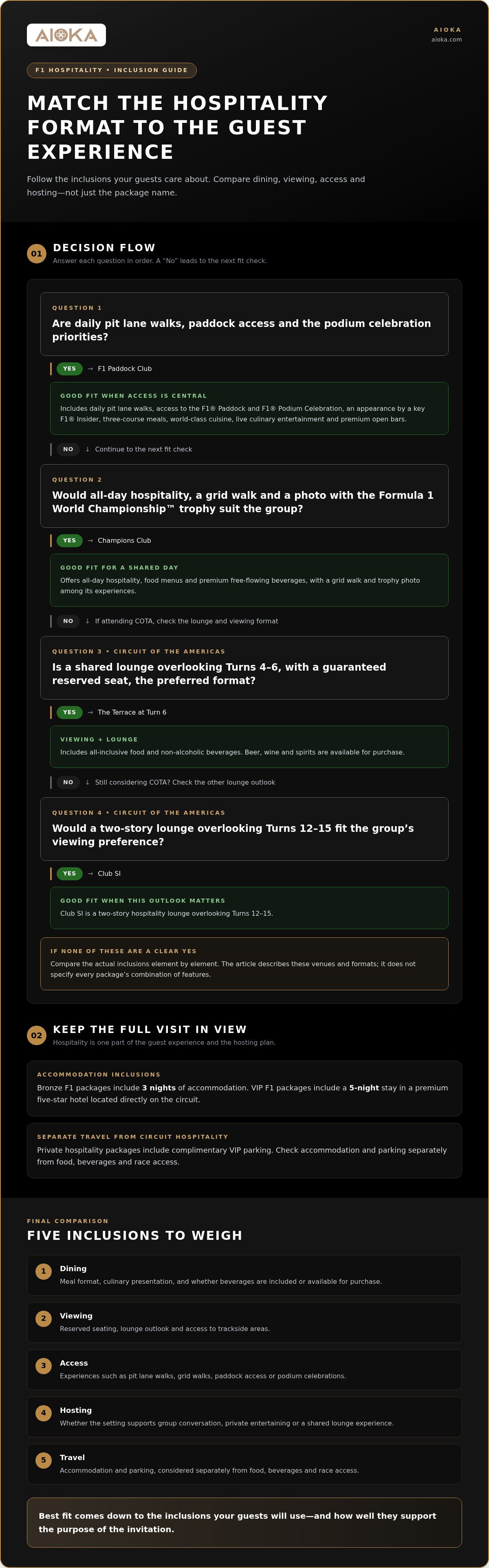
The F1 Paddock Club includes daily pit lane walks during race weekends. Its hospitality features world-class cuisine, live culinary entertainment and premium open bars. Guests also receive an appearance by a key F1® Insider. Access includes the F1® Paddock and F1® Podium Celebration. Three-course meals are served during race weekend. Together, these inclusions provide varied points of engagement beyond a single viewing location.
Champions Club offers all-day hospitality, with food menus and premium, free-flowing beverages. Its experiences include a grid walk and a photo with the Formula 1 World Championship™ trophy. These features create a different rhythm from seated dining alone. A host can use the shared day to move between hospitality, trackside activity and conversation. The grid walk offers a memorable focal point for guests interested in the sport.
At Circuit of The Americas, The Terrace at Turn 6 is a shared hospitality lounge overlooking Turns 4-6. The package includes a guaranteed reserved seat and all-inclusive food and non-alcoholic beverages. Beer, wine and spirits are available for purchase. Club SI is a two-story hospitality lounge overlooking Turns 12-15. Comparing these venues means considering both the viewing location and the format of the hospitality space.
Private hospitality packages include complimentary VIP parking. Accommodation can also form part of a package: Bronze F1 packages include three nights, while VIP F1 packages include a five-night stay in a premium five-star hotel located directly on the circuit. These inclusions affect the shape of the overall guest experience, especially for a multi-day visit. They also make it useful to distinguish circuit hospitality from travel arrangements when assessing what a package covers.
Use a simple inclusion review before selecting an experience:
Dining
Compare meal formats, culinary presentation and whether beverages are included or available for purchase.
Viewing
Note reserved seating, lounge outlook and access to trackside areas.
Access
Identify experiences such as pit lane walks, grid walks, paddock access or podium celebrations.
Hosting
Consider whether the setting supports group conversation, private entertaining or a shared lounge experience.
Travel
Separate accommodation and parking inclusions from food, beverage and race access.
This comparison clarifies what guests will experience across the weekend. For instance, a host prioritising food and conversation may value an all-day hospitality format, while a motorsport enthusiast may place greater weight on pit lane or grid access. A considered F1 hospitality cost benefit analysis therefore looks beyond headline access. It weighs each inclusion against the guests’ interests and the intended purpose of the invitation.
For a final comparison, separate what happens during the event from what supports the wider visit. An appearance by a key F1® Insider is included in F1 Paddock Club packages, adding a hosted moment to the food, viewing and access elements already considered. Decide whether that kind of experience matters to your guests, or whether their priorities are better served by a reserved seat, a lounge outlook or time for conversation. The best fit depends on which inclusions will be used, rather than the length of the package description.
Accommodation can also change how guests experience a multi-day visit. Bronze F1 packages include 3 nights of accommodation. VIP F1 packages include a 5-night stay in a premium five-star hotel located directly on the circuit. Compare these stays alongside the hospitality itself, and check whether the package’s travel arrangements match the group’s plans. A clear review of dining, viewing, access, hosting and accommodation helps identify the experience that fits the purpose of the visit, without assuming that every package offers the same combination.
What factors affect F1 hospitality costs, such as race location and weekend length?
Race location shapes the wider budget because demand for hotels and transport changes by destination. Hotel rates in Grand Prix destinations rise by an average of 105 percent during race weekends compared with the previous weekend’s regular demand. The scale differs sharply between events. Hotel prices in Azerbaijan increased by 281 percent during Grand Prix weekend, while rates in Japan increased by 276 percent. These figures concern accommodation, not hospitality package prices, but they show why location matters to the full hosting budget.
Accommodation rates also vary in absolute terms. These comparisons help companies separate package inclusions from the wider cost of bringing guests to a race. A lower hospitality outlay may not mean a lower total trip budget if local lodging is costly.
Demand pressure can affect planning well before the first practice session. According to the Simon-Kucher study, nearly 32 percent of hotels across Grand Prix host cities were already sold out two months before the 2025 season started. The study analyzed 2,800 hotels across 24 Grand Prix destinations. This provides context for early coordination: accommodation choices, guest travel dates and the number of nights can shape the total commitment even when the hospitality element itself is unchanged.
Weekend length matters because each additional day can add accommodation, meals, local transport and time away from work. A Thursday arrival followed by departure on race day creates a different expense profile from a longer stay. Compare the itinerary with the event schedule, then identify which nights are essential to the guests’ intended experience. Package inclusions can also change the calculation. Separate any accommodation included in a package from nights booked independently.
Hospitality format is another cost driver. A shared lounge, private setting and trackside location each create different hosting conditions. The value of those differences depends on the guest group and event objective. For example, a company hosting several clients may prioritise a setting that encourages conversation, while a motorsport-focused invitation may place greater value on circuit access. Pair each package’s inclusions with the reason for inviting guests when comparing costs.
Use this sequence to build a clearer comparison:
Set the destination
Compare local accommodation demand, using the Canadian Grand Prix and Abu Dhabi as examples of different nightly rates.
Map the schedule
Count required travel days and nights for each guest, including any stay beyond package inclusions.
Separate costs
Record hospitality, accommodation, transport and meals as distinct budget categories.
Match format to purpose
Compare shared and private settings against the kind of client interaction planned.
Review timing
Use the Simon-Kucher finding on early hotel sell-outs to inform when travel arrangements are made.
Race weekends can also produce steep local increases: hotel rates rose by 237 percent in Belgium, 193 percent in Australia, 186 percent in Austria and 154 percent in Monaco. In some Grand Prix destinations, hotel prices triple during race weekends. For an F1 hospitality cost benefit analysis, treat those figures as location-specific context rather than a universal forecast. The most useful comparison combines destination, stay length, hospitality format and what the package covers, so each expense is assessed against the intended guest experience.
How can businesses calculate the ROI of F1 hospitality for client entertainment?
Measure return against a defined business objective, not the spectacle of the race alone. A disciplined F1 hospitality cost benefit analysis connects the event’s complete cost with outcomes that can be traced to invited clients. Those outcomes might include a progressed opportunity, a renewed relationship or a substantive follow-up meeting. Set the objective before invitations are sent, then record the evidence that indicates progress.
Start with the full event cost. Include hospitality, guest travel, accommodation, local transport, meals outside the package and internal staff time. Keep each category distinct. If a package includes accommodation, for example, record that inclusion without counting the same room expense again. This prevents an inflated total and makes comparisons between destinations and formats more meaningful.
Next, define what counts as a business outcome. A signed agreement is measurable, but it may take time and involve several interactions. A qualified opportunity, an agreed proposal meeting or a renewal discussion can serve as useful interim indicators. Record the client, the opportunity, its stage before the event and the agreed next action. A simple client-by-client log gives the hosting team a consistent record.
Use a clear formula when attributable gross profit can be estimated:
ROI = (attributable gross profit − total event cost) ÷ total event cost × 100.
Use gross profit rather than total contract value in the calculation, because revenue alone omits the cost of delivering the work. Attribute only the portion reasonably connected to the hospitality relationship. If several interactions contributed, document the basis for the allocation instead of assigning the entire result to the race weekend.
Not every valuable outcome appears immediately in a financial report. A client may leave with greater familiarity, a clearer understanding of your organisation or a planned conversation with decision-makers. Treat these as relationship indicators, not booked revenue. For example, record whether a guest accepted a follow-up meeting, introduced another stakeholder or advanced an existing discussion. Review these indicators alongside financial outcomes after the event.
Compare results with the original objective and the alternative use of the same budget. If the purpose was to deepen a specific client relationship, assess the resulting engagement against that aim. If it was to advance several opportunities, examine each account separately. This avoids treating broad event attendance as proof of commercial return. A concise post-event review should identify what worked, what did not and what to change next time.
Apply the following sequence to make the assessment repeatable:
Set the objective
Name the target accounts and intended business outcomes.
Establish a baseline
Record each relationship or opportunity’s position before invitations.
Track engagement
Log attendance, meaningful conversations and agreed follow-up actions.
Reconcile costs
Include direct event expenses and relevant internal time without duplication.
Review attribution
Connect later outcomes to documented interactions, using a consistent method.
For example, a sales team hosting an established client can compare the account’s pre-event status with its next proposal discussion and subsequent progress. Do not give the event sole credit if other meetings also shaped the result. Record those contributions, calculate financial return where the evidence supports it, and keep relationship measures separate. This creates a more credible assessment for future hospitality decisions.
Track each follow-up rather than treating a broad impression as proof. The review should also note whether the follow-up happened and whether the opportunity changed stage, while keeping the record concise enough for consistent use.
Formula racing history provides context for the setting, but it does not demonstrate commercial value for any particular host. Keep the evaluation centered on the invited clients, their stated objectives and documented next steps. A useful review also asks whether the same budget could have supported another client-facing activity, and records the reasoning behind the choice. This makes later comparisons more disciplined without assuming that attendance alone caused an outcome. Where attribution remains uncertain, describe the outcome as an indicator rather than assigning a financial return. Retain that distinction when sharing findings internally, so future decisions reflect both measurable results and the limits of the evidence.
What risks or hidden costs should buyers consider when booking F1 hospitality
A polished hospitality itinerary can still conceal gaps between the invitation and the guest’s actual experience. Assess the package scope, destination logistics, guest commitments and financial exposure separately. For example, a hosted race-day experience may not cover the flights, hotel nights or local transfers needed to bring a client to the circuit. A complete budget records each element once and assigns it to the right category.
Package descriptions require close reading. Separate access, dining, beverages, parking, accommodation and event activities in a written inclusion list. The Terrace at Turn 6, for example, includes all-inclusive food and non-alcoholic beverages, while beer, wine and spirits are available for purchase. That distinction affects the guest experience and the event’s additional spend. Compare every proposed package against the planned hosting format before invitations are issued.
Travel creates another layer of exposure. A client arriving from another city needs a workable route from airport to hotel and circuit, while a multi-day itinerary may require accommodation beyond the hospitality schedule. Treat local lodging as a distinct budget line rather than assuming hospitality covers the full trip.
Guest attendance can also affect value. If a senior invitee cancels, the business may lose the intended relationship opportunity while retaining travel and hosting commitments. Create a guest plan with a primary invitee, a suitable alternate and a clear internal owner for each invitation. Before committing, review booking terms for cancellation, transfer and date-change provisions. Those terms determine how the organisation can respond when plans shift.
Operational details can lead to unplanned expenditure. A late arrival might require a separate transfer; a long gap between scheduled activities could prompt additional meals; and the host team may need preparation time or printed materials. For a client meeting planned around a race session, create a practical run sheet covering arrival, guest reception, key conversations and departure. This reveals logistical gaps before they become last-minute purchases.
Currency and payment arrangements deserve attention for international races. If a company budgets in one currency but pays suppliers in another, exchange-rate movements can change the final amount. Record the currency for each expense, the payment date and the responsible department. Keep discretionary spending, such as beverages available for purchase, separate from committed package costs. This makes reconciliation more precise after the event.
Use this pre-booking review to surface exposure:
Scope
List inclusions and exclusions for access, food, beverages, accommodation and transport.
Itinerary
Map each guest’s arrival, circuit transfer, hosted activities and departure.
Attendance
Assign invitees, alternates and an internal relationship owner.
Terms
Review cancellation, transfer and change provisions before committing.
Reconciliation
Track planned expenses separately from discretionary spending and post-event additions.
For a structured review of the guest experience and its practical requirements, plan your F1 hospitality experience around the event’s objectives, inclusions and logistics. A clear scope and guest itinerary help decision-makers distinguish deliberate investment from avoidable expense.
AIOKA: Corporate Hospitality Packages
AIOKA is a natural next step when your F1 hosting plan needs to unite guest experience with business objectives. Its Corporate Hospitality Packages support companies seeking a considered setting for client entertainment, while Curated Culinary Experiences bring food and beverage choices into the occasion. Brand Activation Services can also help businesses incorporate their brand into an event experience.
Turn to AIOKA once you have identified your guest priorities, preferred hospitality format and intended outcomes, and want to shape them into a cohesive plan. A clear brief can connect the client relationship, culinary experience and brand presence while keeping the event’s purpose in focus.
To discuss your F1 hospitality plans, visit aioka.com.
Shape the Invitation Around the Relationship
The most enduring value of a race weekend begins before guests arrive, with a clear purpose for bringing them together. Decide which relationships merit a distinctive setting, what conversations you hope to advance and how the experience should reflect your organisation. That intention gives each hospitality decision a sharper commercial measure.
AIOKA’s Corporate Hospitality Packages, Brand Activation Services and Curated Culinary Experiences offer complementary ways to shape that occasion. Consider how the elements can serve your guests and business objectives, rather than treating the event as an isolated reward. A thoughtful F1 hospitality cost benefit analysis keeps the experience aligned with a relationship strategy and provides a sound basis for future decisions.
If you are ready to consider how an F1 weekend could support your client relationships, contact AIOKA about F1 hospitality. Begin with the guests and outcomes that matter most, then let that purpose guide the experience.
Frequently Asked Questions
Which F1 hospitality packages offer the best value for money?
The best-value package is the one whose inclusions align closely with your guests’ priorities and your hosting objective. For a small executive group, a setting that enables uninterrupted conversation may matter more than access activities guests will not use. For clients who follow Formula 1 closely, trackside access or racing experiences may carry greater value. Compare the package against a short list of must-haves, then discount features that add little to the occasion.


