
Formula 1 Incentive Travel Packages and Program Costs
A clear breakdown of what an F1 incentive trip costs, from flights and hotels to contingency, and how to arrive at a sensible per-person budget.
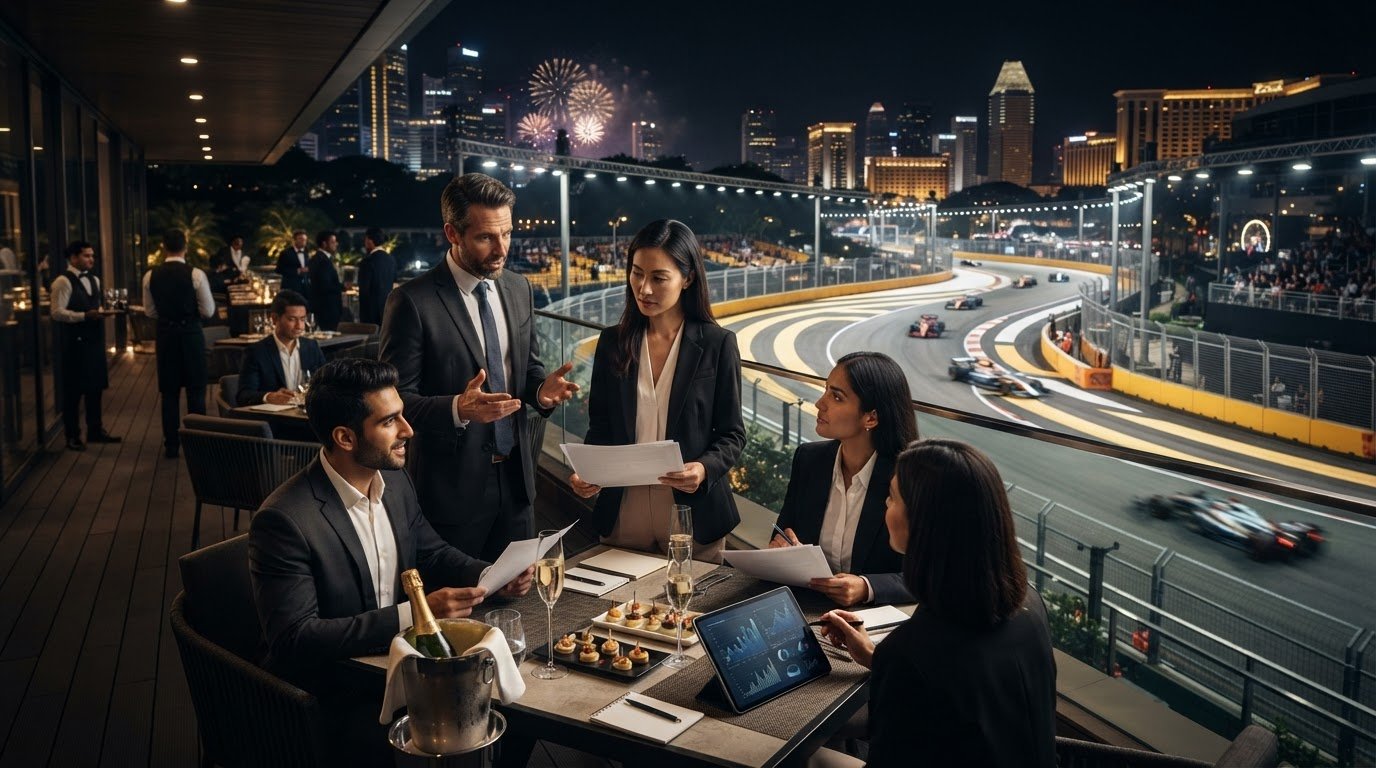
The total cost of Formula 1 incentive travel packages is built from the participant expenses and fixed program costs, then shaped by the destination, group size, and length of the experience. To estimate a per-person budget, divide the complete program total by the number of attendees, including any guests. The final figure depends on the experience being designed, not on a single universal rate.
It’s reasonable to expect the race weekend to be only one part of the budget. Airfare, accommodation, food and beverage, activities, taxes, service charges, gratuities, and contingency funds all affect the total, while customization can change the scope considerably.
This guide explains which costs to include, how to calculate a total and per-person estimate, and how to assess the program’s value against its business objectives. It also explains when specialist planning can bring hospitality, logistics, and brand experiences together in a cohesive incentive program.
Key Takeaways
• Build your budget around both participant expenses and fixed program costs, with taxes, service charges, gratuities, and contingency included.
• Assess how destination, travel arrangements, accommodation, activities, group size, and program length shape the overall investment.
• Estimate the per-person figure by dividing the complete program budget by the number of participants and their guests.
• Set clear business objectives before selecting the experience, then identify the measures that will help assess its contribution.
• Consider specialist support when coordinating a complex race-weekend experience or aligning corporate hospitality with a brand activation.
What should an incentive travel budget include?
Start with the full program scope, not just the race experience. A sound budget links every attendee, guest, destination, and activity to a clear business objective.
Core Budget Components
Build the budget around participant expenses and fixed program costs. Include airfare, accommodation, food and beverage, activities, event costs, taxes, service charges, gratuities, and contingency funds. Count winners and any guests they may bring, since each additional attendee affects rooms, meals, transportation, and access arrangements. Assign every cost to a budget owner and note what it covers.
Cost and Experience Factors
Destination, group size, program length, and customization shape the experience and its budget. An international Grand Prix may require more coordinated travel planning than a local sports event, while a tailored itinerary adds decisions around dining, activities, and shared time. Start by setting up to three specific, measurable objectives. For example, an objective could be increasing gross profit from qualifying product lines by 10% during the program period.
Group Logistics and Budget Control
Assign one planning lead to maintain the live budget, attendee count, and decision log. Coordinate flight arrivals, hotel rooming, ground transportation, event schedules, and dietary requirements in one operating plan. Track committed and estimated costs separately, and record changes when attendees or program elements shift. A contingency line can absorb unforeseen expenses without obscuring the approved core budget.
How do F1 incentive packages compare with other corporate sports travel experiences? Formula 1 centers the itinerary on a race weekend, combining trackside viewing with hospitality and planned corporate moments. Other sports experiences can be shaped around their own event schedules and settings.
What are the booking deadlines and deposit or cancellation rules for F1 group packages? The booking timeline and payment terms depend on the package’s contract and event arrangements. Review the deposit schedule, cancellation provisions, attendee changes, and payment dates as part of budget approval.
What are the visa, entry, and ticket rules for attending a Formula 1 Grand Prix? Entry requirements depend on each attendee’s nationality and destination, while ticket terms depend on the event and ticket type. Include travel-document planning and ticket access in the itinerary before finalizing attendee arrangements.
How can companies customize an F1 incentive trip for employees or clients? Align the itinerary with the audience and objective, then plan hospitality, dining, group activities, and brand moments around the race schedule. A sales reward, for example, may emphasize client hosting, while an employee program may prioritize recognition and shared experiences.
How many people can an F1 incentive travel package accommodate? Capacity depends on the selected hospitality setting, accommodation, transportation, and event access. Set the attendee target first, then coordinate those elements around the group’s size and needs.
Cross-functional coordination keeps the program commercially focused. Finance can oversee approvals and contingency, human resources can define eligibility and recognition, and sales or marketing can link the experience to loyalty and client relationships. A shared objective, such as strengthening channel-partner loyalty, gives each team a consistent basis for decisions and evaluation.
How Much Does an Incentive Travel Program Cost?
A program total depends on its destination, travel arrangements, accommodation, group size, and planned activities. For Formula 1, begin by defining the race-weekend experience, then build the budget around the travel and hospitality required to deliver it.
What do Formula 1 incentive travel packages include? They can bring together race-weekend hospitality, accommodation, flights, ground transportation, meals, and curated activities. The itinerary determines which elements are central and how they fit together.
Destination and Seasonal Costs
The destination affects airfare, hotel availability, local transportation, and the effort needed to coordinate attendees. Season matters too: demand around a major race weekend can influence room availability and the range of suitable stays. Compare destinations against the sales objective, attendees’ travel origins, and the time available for shared activities, rather than choosing on prestige alone.
These are overall incentive-program estimates, not prices for a specific Formula 1 package.
Travel and Stay Expenses
Airfare and accommodation are often among the largest program expenses. Estimate travel based on attendees’ departure points, destination, room requirements, and length of stay. Add food and beverage, event activities, and local transportation. A shorter itinerary may reduce nights away, while a longer stay can allow more time for client relationships and group experiences.
Separate costs into useful categories before comparing itineraries: flights, lodging, meals, transfers, activities, and event expenses. This shows whether a proposed change affects one attendee, the whole group, or a fixed program cost. For example, adding a hosted dinner changes the activity budget, while changing hotels may also affect transportation and scheduling.
Destination Selection and Logistics
Evaluate each destination across the full journey, from arrival airport to hotel, event setting, and planned activities. A location with appealing hospitality may still require more transfers or careful arrival coordination. Map attendee origins, arrival windows, rooming needs, and event movements before confirming the itinerary.
Planning well in advance gives organizers more flexibility to compare destinations, assess hotel availability, negotiate contracts, and secure experiences. For international travel, coordinate the group’s travel information and schedules. The strongest choice is the destination whose logistics support the program’s purpose, whether that is motivating employees, recognizing a sales team, or strengthening business relationships.
Airfare and ground transportation
For a race-weekend program, transport links each employee’s arrival to the itinerary’s first scheduled experience. Plan movements around attendee origins, arrival windows, hotel locations, and event access, then assign a supplier to each journey segment.
Coordinating Air Travel
Start with a travel profile for the audience: home cities, preferred airports, and any accessibility requirements. Grouping arrivals can simplify transfers, while separate flight plans may better suit employees traveling from different regions. Compare options against the program design, including arrival timing, connection complexity, and the impact of a delayed flight.
Keep airfare estimates separate from ground transport. Record the route, fare conditions, baggage assumptions, and change terms for each traveler. If a sales team arrives across several time windows, don’t treat everyone as one flight group. A shared arrival schedule helps planners match pickups to actual itineraries.
Planning Ground Transfers
Map each journey from airport to hotel, hotel to event, and event back to accommodation. For example, a group arriving at different times may need scheduled transfer waves rather than one vehicle departure. Match vehicle capacity to passengers and luggage, then document pickup points, arrival details, and the responsible on-site coordinator.
Race-weekend traffic can disrupt planned movements, so build realistic travel buffers into the schedule. Compare the locations of the hotel, circuit, and hosted activities before arranging transfers. A distant hotel may require more coordination, while a central base may simplify travel between scheduled engagements.
Managing Suppliers and Changes
Assign one lead for flight records and another for ground movements, even if one supplier supports both. Keep the attendee manifest, arrival schedule, hotel details, and transfer assignments in one controlled document. When an employee changes flights, update the pickup plan and promptly notify the relevant transport supplier.
Budget control improves when estimates, commitments, and changes are visible. Track airfare separately from transfers, and record the reason for each adjustment. For instance, a late arrival might require a revised pickup, while a hotel change could alter several routes. This record helps finance understand changes to the transport budget.
Before booking
Match attendee origins and arrival windows to the itinerary.
Before travel
Reconcile flight details, passenger names, luggage needs, and pickup instructions.
During the event
Use one coordinator to communicate schedule changes to attendees and suppliers.
Transportation should support the experience, not dictate it. Carefully sequenced arrivals, a clear route to the circuit, and coordinated suppliers let attendees focus on the event. Thoughtful planning can make an incentive journey distinctive and memorable while keeping its practical requirements clear.
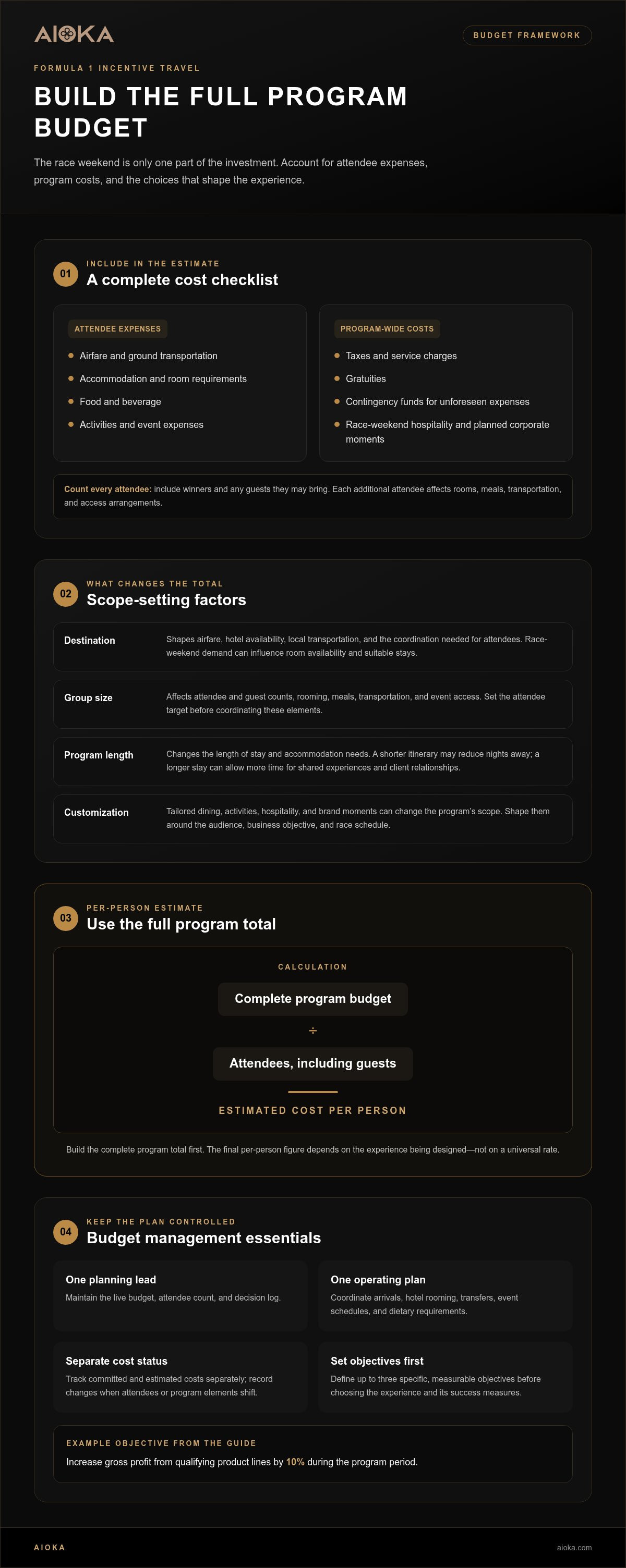
Estimating total and per-person costs
Build the estimate from a complete program budget, then divide it by the planned attendee count. This separates the total investment from the amount per participant, including guests whose travel and participation affect both figures.
Assembling the Program Total
Use the example incentive program as a model for organizing costs, not as a price quote.
Give each category its own line in your worksheet and note whether its cost changes with attendance. Airfare, rooms, meals, and local transport usually scale with participants; communications planning or some event costs may be fixed. This distinction shows how a change in attendee count affects the estimate and provides a clear basis for approval.
Calculating the Per-Person Estimate
Divide the total program estimate by the number of attendees included in that total. If the budget includes accompanying guests, count them in the denominator and include their related expenses in the numerator. Make the assumptions visible: a per-person figure means little unless it’s clear whose airfare, accommodation, and activities it covers.
For a practical calculation, update both the total and headcount whenever the attendee list changes. Adding a guest may also mean another room, meal, transfer, or activity place. Recalculate the total first, then divide by the revised participant count to avoid presenting an outdated estimate.
Testing the Estimate Against the Reward
Compare the planned investment with the program’s purpose before finalizing the itinerary. An incentive trip meant to reward high performance may prioritize the race experience and shared hospitality, while a client-focused program may emphasize relationship-building. Each choice changes the cost mix, so identify the elements that directly support the objective.
Set a working estimate, document assumptions, and compare alternatives by their budget impact. For example, weigh a shorter stay against an expanded activity schedule, or assess how a different destination changes airfare and accommodation together. The goal is a memorable reward with a cost structure leadership can understand.
Keeping Budget Assumptions Current
Maintain one version-controlled estimate that includes a date, attendee count, and category owner. Mark each amount as estimated or committed, then update it when flights, accommodation, or program plans change. This makes the latest total traceable and gives finance a consistent basis for reviewing the incentive trip.
Before approval, reconcile the summary with the detailed worksheet. Confirm that every attendee has a defined status, every major category appears once, and the per-person calculation uses the same total and headcount. These checks help prevent overlooked expenses and make the final reward easier to assess.
Hiring an incentive travel company
A specialist can coordinate the moving parts of an international race-weekend program, from planning through on-site execution. Consider expert support when attendee logistics, suppliers, and the experience itself need sustained coordination.
What risks should companies consider when booking an F1 incentive trip? Key risks include changes to attendee numbers, travel disruptions, limited hotel availability, unclear contract terms, and mismatched schedules. Record responsibilities, payment and cancellation terms, and contingency plans before committing the investment.
Choosing a Travel Partner
Choose a partner whose planning approach serves the program objective, not just the event itinerary. Ask how they coordinate attendees, suppliers, accommodation, transportation, and on-site support, then review how those responsibilities appear in the proposed plan. Large groups, international destinations, and specific hotel or experience requirements call for a longer planning window.
Agree on roles before planning begins. For example, the company can define eligibility for top performers while its travel partner coordinates the attendee schedule and supplier communications. Establish an approval process for itinerary changes and maintain a shared decision record. This gives finance, human resources, and sales a common view of execution.
Decide whether the program needs an on-site travel manager. This role can coordinate transportation, run the hospitality desk, and supervise support staff and suppliers during the trip. For a complex race-weekend schedule, assigning that responsibility in advance provides a clear coordination point for attendees and partners.
Booking Risks to Consider
Contract clarity matters. Review each supplier’s responsibilities, payment schedule, cancellation terms, and how attendee changes affect arrangements. Keep the event itinerary aligned with travel timings, since a flight delay or revised arrival can affect transportation and scheduled activities.
Availability also needs to be considered. Start early when the program calls for a particular hotel or experience, especially for an international destination or a large group. Early planning allows more flexibility to compare destinations, assess hotel availability, negotiate contracts, and secure experiences. Keep key dates and decisions in one planning document.
Protect the program’s purpose as details evolve. Set up to three specific, measurable objectives, then choose three to five primary key performance indicators that support them directly. For a sales incentive, a company might track gross profit rather than total revenue when assessing results. This keeps the experience connected to the business case instead of letting logistics drive every decision.
Before approval, align the travel partner’s responsibilities with your internal owners. Name one person to approve itinerary changes, one to maintain attendee records, and one to coordinate performance measurement. Explore support for your Formula 1 program design when a race-weekend experience calls for carefully coordinated execution.
AIOKA: Corporate Hospitality Packages
AIOKA helps organizations shape Formula 1 race weekends into considered corporate experiences through Corporate Hospitality Packages. For a program centered on client hosting or recognizing top performers, these experiences bring together trackside settings, elevated culinary moments, and opportunities for meaningful business connection.
When the objective extends beyond hospitality, AIOKA’s immersive brand activations can give a brand a deliberate presence within the experience. Curated culinary experiences add another dimension to guest hosting. The right fit depends on the audience, the program’s purpose, and the atmosphere the organization wants to create.
For a considered next step, contact AIOKA or visit aioka.com to discuss your Formula 1 incentive travel plans.
Shape the Experience Around What Comes Next
The strongest incentive experiences are designed with an afterthought in mind: what participants should carry into their work and relationships once the race weekend has passed. Let that intention guide the final choices, from the atmosphere you create to the conversations you hope to encourage. Formula 1 incentive travel packages can become more than a distinguished reward when the experience reflects a clear purpose and feels considered for its audience.
AIOKA offers Corporate Hospitality Packages, Brand Activation Services, and Curated Culinary Experiences for organizations shaping corporate moments around Formula 1. These offerings can support a program centered on client connection, brand presence, or meaningful recognition, with the experience tailored to its intended role.
When you’re ready to develop your next race-weekend program, contact AIOKA to plan your trip. Begin with the people you want to bring together and the impression you want the experience to leave; from there, a considered plan can take shape.
Frequently Asked Questions
What Costs Should Be Included?
Include expenses that vary with attendance alongside the costs of developing and operating the program. For example, distinguish per-attendee meals from production or communications costs that may remain stable as the guest list changes. Add taxes, service charges, gratuities, and contingency. Assign an internal owner to each category so finance can trace assumptions and spot duplicate expenses before approving the plan.
How much do Formula 1 corporate incentive travel packages cost?
There is no single standard cost for an F1 corporate incentive experience. The estimate depends on the destination, attendee count, length of stay, travel arrangements, and the level of hospitality and activities planned. For a bespoke program, the price depends on the case and is provided after a quote request. Share the intended audience and purpose to help shape an estimate around the experience you have in mind.
Which F1 races offer the best incentive travel experiences?
The right race depends on the audience, business objective, and practical travel needs. Monaco may suit a program centered on an iconic setting, while Miami or Austin may appeal to groups seeking a U.S. destination. Singapore offers a distinctive international city setting. Compare attendee origins, event atmosphere, and opportunities for hosted experiences, then choose the race that best supports the relationships your program aims to advance.
What hospitality and VIP packages are available at Formula 1 races?
Corporate hospitality can be built around trackside suites or luxury yachts, with curated dining and private client entertaining facilities. AIOKA also offers brand activations and curated culinary experiences for programs seeking a stronger brand or dining dimension. The right combination depends on whether the occasion is designed to recognize employees, host clients, or create a considered setting for business engagement.
What travel, hotel, and transportation options are included in F1 packages?
Treat travel, accommodation, and ground transportation as distinct itinerary elements, since arrangements depend on attendee origins, destination, and schedule. A group arriving at different times, for example, may need coordinated airport pickups rather than a single transfer. Review the itinerary’s inclusions alongside event hospitality, dining, and activities so participants understand which arrangements are part of the planned experience.
Which U.S. travel companies specialize in Formula 1 incentive packages?
AIOKA serves corporate clients at Formula 1 race weekends worldwide, making it an option for U.S. organizations planning an international or domestic event experience. Its work focuses on corporate hospitality, brand activations, and curated culinary experiences rather than general travel alone. For a suitable partnership, define whether your priority is employee recognition, client hosting, or a brand-led event, then align the program scope with that objective.


