
Senior Executive Networking Event Ideas for Better Peer Exchange
Practical formats for senior leaders, from intimate peer roundtables to coffee pop-ups and larger gatherings, with advice on matching each to group size.
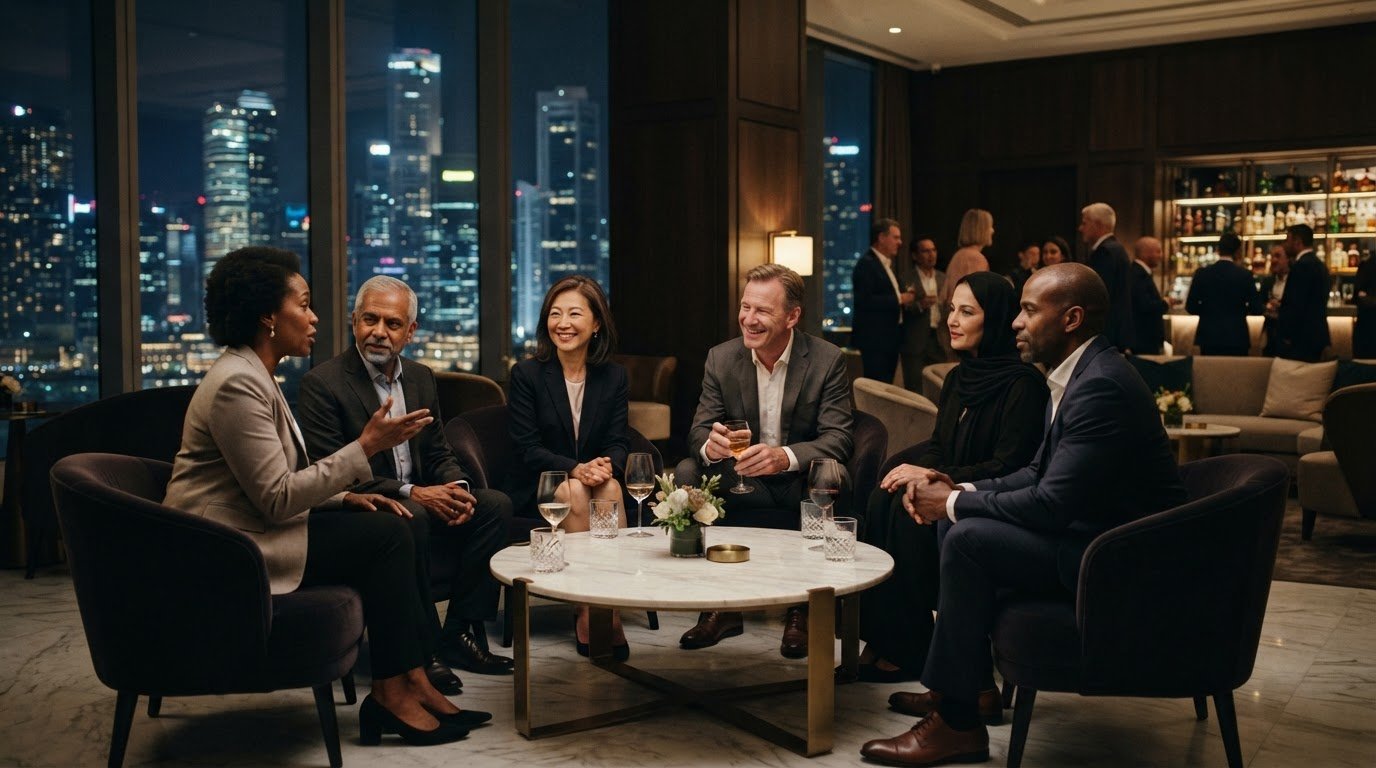
The most effective senior executive networking event ideas begin with the room, not the activity: peer roundtables work best with 6-8 people, while speed networking can scale from 20 to 200 attendees. Match each format to the audience, event purpose and desired depth of exchange. At larger gatherings, purposeful activities help turn a broad room into meaningful conversations.
Games and structured activities can ease introductions, give conversations a natural focus, and help guests connect beyond familiar circles. For senior leaders, the strongest formats respect their time and experience, making space for candid exchange without forcing interaction.
Choose a format suited to your group, from coffee pop-ups and focused peer roundtables to activities for large-scale events. These practical ideas address different group sizes and networking goals, with guidance on balancing structure and the freedom for valuable conversations to develop.
Key Takeaways
• Choose a format around the purpose of the gathering, the audience and the group size, balancing thoughtful structure with room for natural conversation.
• Use rotating coffee conversations to create approachable introductions and help guests move beyond the people they already know.
• Keep peer roundtables focused with a small group, prepared discussion prompts and a facilitator who makes space for each perspective.
• For larger gatherings, design activities that help attendees find relevant connections without letting the mechanics overshadow the exchange.
1. Matching event formats to audience goals and group size
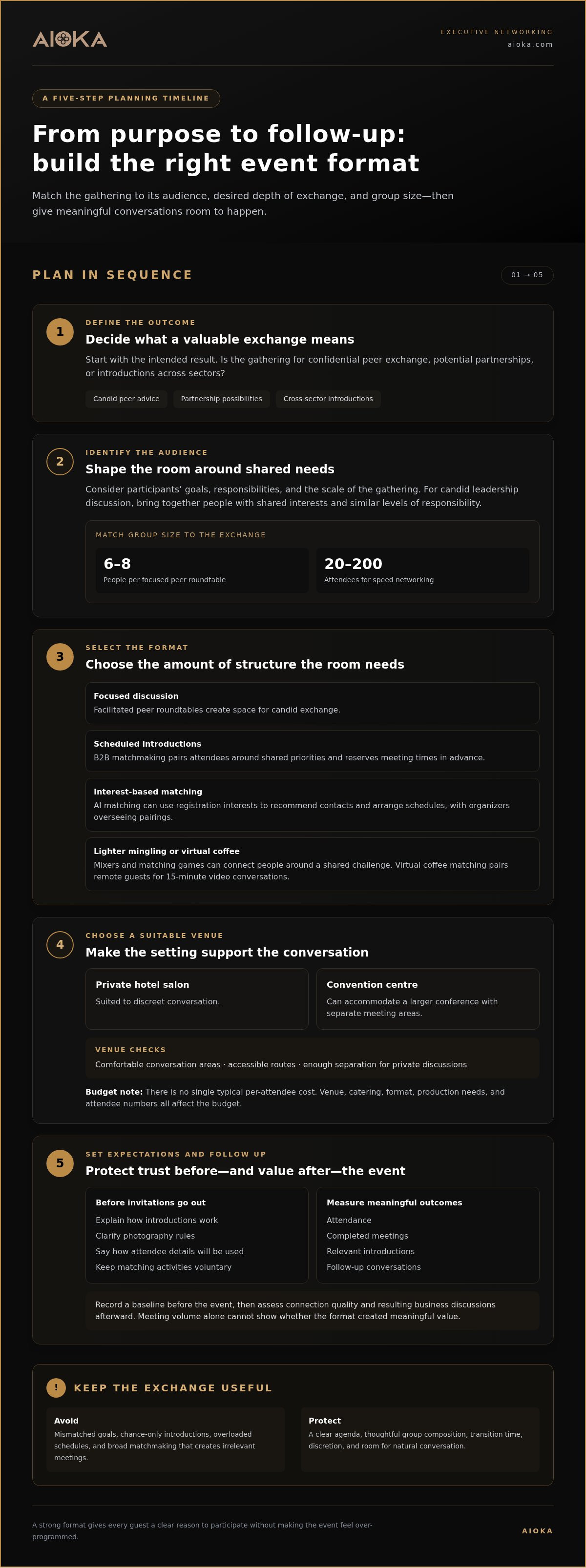
Begin with the intended outcome: confidential peer exchange, potential partnerships, or introductions across sectors. For focused discussion, place 6-8 people in each roundtable; for broader introductions, speed networking can accommodate 20 to 200 attendees. The right format gives every guest a clear reason to participate without making the conference feel over-programmed.
The venue shapes the quality of these exchanges. A private hotel salon suits discreet conversation, while a convention centre can accommodate a larger conference with separate meeting areas. Hotels and convention centres are among the meeting sites planners consider, according to the U.S. Bureau of Labor Statistics. Look for comfortable conversation areas, accessible routes, and enough separation for private discussions.
Set expectations before invitations go out: explain how introductions work, clarify photography rules, and say how attendee details will be used. Keep sensitive business discussions within the group, and make matching activities voluntary. Clear expectations build trust, particularly when executives share views on strategy, leadership, or market challenges.
There is no single typical per-attendee cost for an executive networking event in the United States. Venue, catering, format, production needs, and attendee numbers all affect the budget. When coordinating high-stakes presentations and seamless staging, event teams often rely on audio-visual specialists like nextgenav.com.au to handle the technical execution. Assess each component against the experience and business purpose you intend to deliver.
Plan in sequence: define the outcome, identify the audience, select the format, choose a suitable venue, then build the invitation and follow-up plan. When orchestrating complex logistics, partnering with experienced management firms such as fruitbowl.com.au can help bring these elements together, whether facilitating an intimate executive roundtable or scheduling introductions for a larger conference.
Structured B2B matchmaking pairs attendees around shared priorities and reserves meeting times in advance. AI matchmaking can use registration interests to recommend relevant contacts and arrange schedules, while organizers retain oversight of pairings. Mixers and matching games offer a lighter alternative: prompt guests to find peers with a shared challenge. For virtual coffee matching, pair remote guests for 15-minute video conversations.
Measure success through attendance, completed meetings, relevant introductions, and follow-up conversations. Record a baseline before the event, then assess the quality of connections and resulting business discussions afterward. Meeting volume alone cannot show whether the format created meaningful value.
Common mistakes include inviting people with mismatched goals, leaving introductions entirely to chance, and overloading the schedule with activities. Broad matchmaking can also lead to irrelevant meetings. Use a clear agenda, thoughtful group composition, and transition time to protect discretion and conversation quality.
2. Coffee pop-ups with rotating conversation stations
A coffee pop-up offers executives an easy entry into conversation without requiring a formal introduction. Arrange stations around distinct topics, such as leadership transitions, market shifts, or talent development. Invite attendees to move between stations every 15 to 20 minutes, giving each exchange enough time to develop before the next conversation begins.
For a more flexible format, use the Coffeehouse Curiosity Pop-Up approach: ring a bell every 10 minutes to signal optional seat swaps. Guests can stay with a promising discussion or choose a new table. This gentle structure encourages mingling while preserving the autonomy senior leaders expect from a professional gathering.
Use prompts that invite considered opinions rather than rehearsed introductions. Place a card at each station with a question such as, “Which leadership practice deserves a rethink?” or “What change is reshaping your career?” Specific topics help guests share experience and find common ground without turning the gathering into a pitch session.
Structured icebreakers can build momentum when guests arrive in unfamiliar groups. Begin with rotating five-minute conversations, offering one prompt before each change. A question about a recent professional lesson can engage the room while keeping each exchange focused and natural.
Name tags can support those introductions. Display each attendee’s name, occupation, and company, then invite them to add a conversation starter. Since 60-70% of attendees may skip an optional prompt field, make it a clear part of registration instead. Keep the prompt concise, such as a current business question or an area of expertise.
Food can also open a conversation. A tasting station featuring contrasting coffees or pastries gives guests a shared experience and an easy first topic. Introduce each selection with a short note, then let the discussion move toward business interests, LinkedIn connections, or mutual acquaintances. For a polished hosted setting, consider thoughtfully designed gathering experiences that bring conversation and hospitality together.
3. Senior leadership and board-level peer roundtables
For candid exchange, arrange round tables with 6-8 people and allow 45-75 minutes. Keep participants at a similar level of responsibility, then assign a facilitator to guide the session. This balance gives each executive space to contribute while keeping discussion anchored to shared leadership interests.
Topics that encourage meaningful executive networking include succession planning, organizational change, talent retention, and responsible growth. Ask participants to submit one pressing question before the event, then collect and group related themes. Prepare three questions to focus discussion without turning the table into a formal presentation.
Reverse mentoring can broaden perspectives across generations and areas of expertise. Use a 15-minute structure in which a senior leader and a less-tenured participant exchange insight on a defined topic, such as workplace technology or emerging talent expectations. For speed mentoring, pair experienced professionals with people seeking guidance for 10 minutes, then rotate partners.
An insight fishbowl suits a group that wants to hear a focused discussion before joining it. Begin with an inner circle of 4-5 participants and leave 1-2 open chairs for observers who wish to contribute. A facilitator can invite new voices into the circle and keep the conversation attentive to the chosen subject.
Virtual executive roundtables need deliberate turn-taking to prevent the most assertive voices from dominating. Share the topic and speaking order before the session, then use video breakouts for 15-minute conversations between remote or hybrid attendees. A brief closing round lets each participant name one useful insight or follow-up connection.
Industry roundtable rotations can connect leaders across sectors without relying on trivia or generic icebreakers. Set a clear question at each table, give participants three minutes to share a perspective, and allow 30 seconds for rotation. Keep the prompt consistent across tables, so attendees can compare ideas and carry a considered discussion into the next session.
4. Activities for large-scale networking events
At a large conference, scale alone won’t create connection; attendees need clear reasons to approach one another. Speed networking can serve groups of 20 to 200, with a focused block lasting 20-60 minutes. A 60-minute session accommodates roughly 15-17 rounds, while a hard 3-minute timer keeps introductions purposeful and transitions predictable.
Rotating conversation zones offer a less formal alternative across a 45-75-minute event block. Give each area a distinct theme, such as market expansion, leadership succession, or customer experience. Leaders can choose discussions relevant to their interests, while visible signs help the audience circulate without crowding one central space.
For guided discovery, use human bingo for 30-45 minutes, with squares describing professional experience or expertise. Guests move through the room to find people who match each prompt, turning introductions into a shared activity. Keep scored activities limited to 5-7, so points support conversation rather than compete with it.
Knowledge exchange zones can host informal sessions or booths for 30 minutes, allowing attendees to share a lesson, challenge, or specialist perspective. A networking workshop can pair a concise presentation with hands-on discussion around one business topic. For deeper collaboration, reserve 2-6 hours for a hackathon, or schedule group activities lasting 60-120 minutes.
Choose one anchor activity based on the event’s purpose, then add only formats that serve the same goal. A broad audience may benefit from conversation zones, while a conference focused on shared business challenges may gain more from workshops. Set transitions and participation instructions in advance, then create space for follow-up conversations. Explore bespoke corporate event experiences for gatherings shaped around considered hospitality and connection.
AIOKA: Corporate Hospitality Packages
AIOKA offers Corporate Hospitality Packages for brands seeking to host clients at Formula 1 race weekends. For executive networking, this setting can bring business guests together around a shared experience, with trackside views and carefully curated culinary offerings creating a natural backdrop for conversation.
When the objective goes beyond hosting, Brand Activation Services can shape the brand experience, while Curated Culinary Experiences provide a considered focal point for the occasion. These offerings suit organizations seeking to combine relationship-building with the distinctive atmosphere of a Grand Prix weekend, rather than a conventional conference.
For a gathering centred on client hospitality, brand presence, and meaningful exchange, contact AIOKA to discuss your event.
Shape the Next Conversation
The most enduring senior executive networking event ideas start with what should happen after the gathering: a renewed partnership, a candid exchange, or a reason to continue the conversation. Let that next step guide the experience, from the atmosphere guests enter to the moments that bring them together. A well-planned event can feel distinctive and purposeful, giving business relationships room to develop beyond the occasion.
For brands hosting clients at Formula 1 race weekends, AIOKA offers Corporate Hospitality Packages, Brand Activation Services, and Curated Culinary Experiences. These offerings provide a setting in which hospitality and brand presence can support the occasion’s wider relationship-building purpose.
Contact AIOKA to plan your event, and take the next step toward a gathering shaped around the connections you value.
Frequently Asked Questions
What Are the Benefits of Using Networking Games and Activities?
Networking games give attendees a shared focus, making first introductions less formal and easier to begin. A thoughtful activity can also reveal expertise or interests that a name badge alone cannot convey. A brief “current challenge” prompt, for example, helps guests identify relevant peers, while a collaborative exercise can surface complementary perspectives before business discussions begin.
What are effective networking event ideas for senior executives?
Senior executive networking event ideas work best when each activity serves a clear business purpose. Options include a confidential peer-advisory exchange, a hosted dinner built around a strategic theme, or a leadership case clinic where guests share perspectives on a real challenge. For a case clinic, invite a participant to outline an issue, then guide peers to offer observations rather than pitches.
What formats work best for executive networking events: roundtables, dinners, retreats, or conferences?
The best format depends on the desired depth and the time executives can commit. Roundtables support focused peer exchange, dinners create a social setting for relationship-building, and retreats give leadership groups space to explore complex priorities away from daily demands. Conferences suit cross-sector reach, particularly when the programme includes hosted introductions and areas for private discussion.
How many attendees is ideal for a senior executive networking event?
There is no universal ideal attendee count. Set it according to the level of direct access the event promises. A gathering centred on confidential discussion benefits from a carefully composed group where everyone can contribute. A broader invitation can work when guests are grouped by industry, role, or shared business interest, giving each person a clear route to relevant connections.
How can organizers facilitate high-quality introductions and follow-up?
For senior executive networking event ideas to lead to useful follow-up, plan introductions around a specific reason to connect: shared market interests, complementary expertise, or a challenge both guests understand. Explain why the introduction may be relevant, then let each person decide whether to continue the conversation. Afterward, send a concise attendee directory or opt-in connection note, and invite guests to record agreed next steps.


